
The Roles We Play

The Person · Guide
The Roles You Play
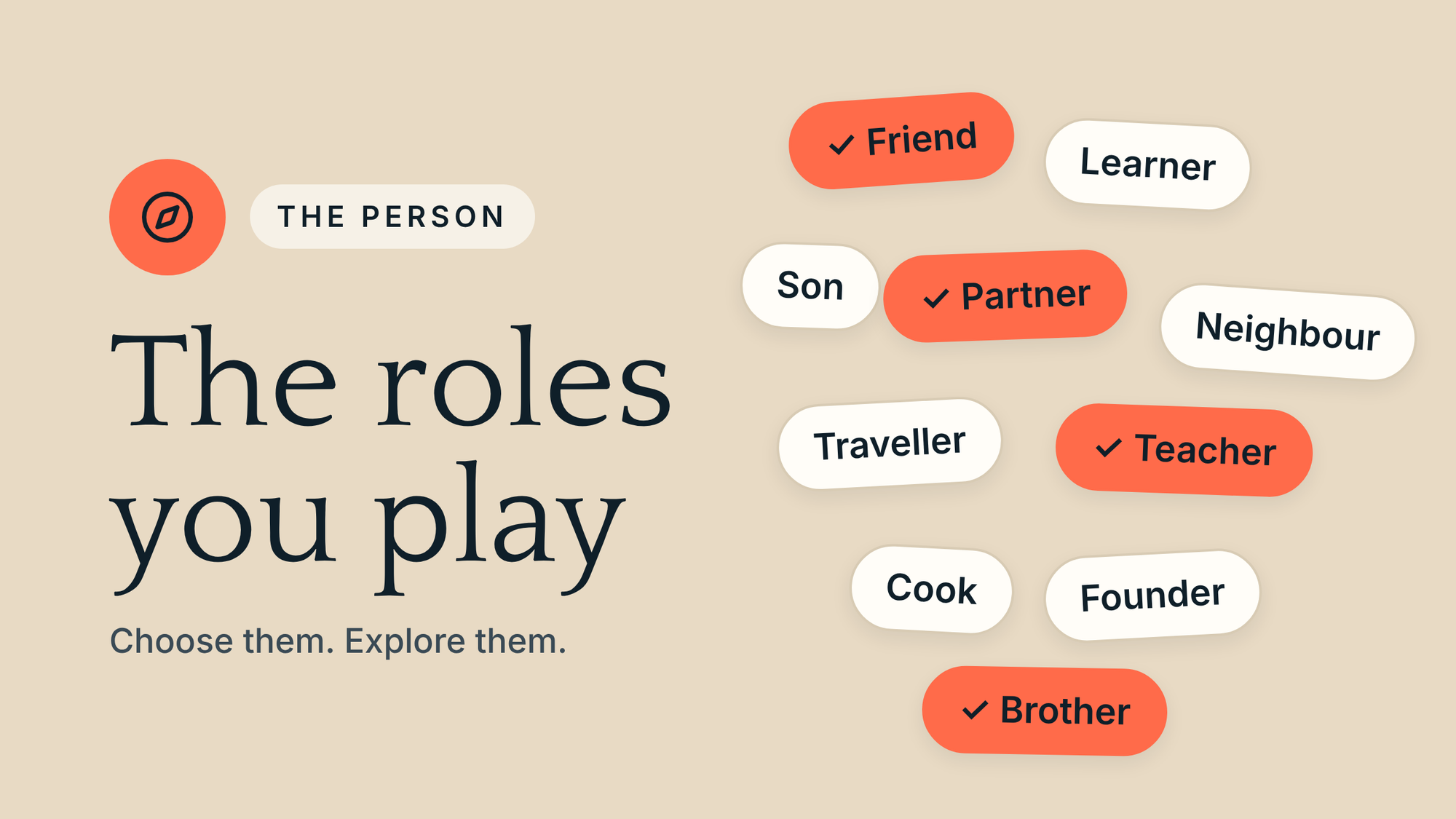
You are never just one person. See all your roles, choose the ones that matter, and decide what you want from each.
Why roles matter
Values tell you what matters. Roles tell you where you live it.
The whole picture
You are more than your job.
The pressure
Stress is often two roles wanting the same hour.
The action
A role gives you something to do this week.
The theory
Six pieces of research that support this exercise
Roles have been studied for more than sixty years. These six ideas explain why looking at your roles is worth your time.
We rank our roles
The sociologist Sheldon Stryker called this identity theory. We hold many role identities, arranged in an order of importance. He found that the more relationships depend on a role, the higher it sits, and the more time we give it.
Feeling stretched is normal
William Goode named this role strain in 1960. He argued that the demands of all our roles together are always more than one person can meet, so we constantly bargain between them. Robert Merton added that even one role comes with several audiences who want different things.
Every role has an audience
Erving Goffman watched everyday life closely and described it as theatre. We play each role on a front stage, where people see us, and recover on a back stage, where we can drop the act. How we behave depends on who is watching.
More roles can protect you
The psychologist Patricia Linville studied self-complexity in the 1980s. In her studies, people who saw themselves through several distinct roles were less shaken by stressful events, because a setback in one role did not spread to the others. Later studies have been more mixed.
Roles change over a lifetime
Donald Super spent decades studying careers and concluded that a career is every role you play, not only your job. His Life-Career Rainbow maps nine roles, from child and student to worker, parent and citizen, and shows how each grows and shrinks with age.
Roles make goals practical
Stephen Covey's method in The 7 Habits of Highly Effective People is practical advice more than research. Choose up to seven roles, then set one or two goals for each role every week. The seven categories below come from his work.
1 Choose
Which roles do you play?
Tap every role that is part of your life right now. Add your own if it is missing. Then narrow down: Covey suggests working with no more than seven.
2 Explore
What does each role ask of you?
Each role you chose appears here. Answer in your own words. Short answers are fine, and you can leave any question blank.
3 Take away
Look at the whole picture
Questions to think about, or to discuss with a partner.
- Which role gives you the most energy? Which takes the most?
- Which two roles compete for the same time?
- Is there a role you would like to play more, or one you have not started yet?
- Finish the sentence: "This week I will spend a little more time as..."