Feedback


People who sound polite don't change the message - they change how it's delivered. A small shift in word choice can be the difference between feedback that lands and feedback that puts someone immediately on the defensive.
When you need to share your opinion or perspective, avoid stating it as a fact. Framing it as a personal view makes it easier to hear and easier to discuss. Phrases like "I feel that…" or "it seems to me that…" signal that you're offering a view, not delivering a verdict.
- "Personally, I think the structure of the report made it harder to follow."
- "I feel that the meeting could have gone better if questions had been taken at the end."
- "It seems to me that the timeline might be too tight to deliver this well."
When you need to make a suggestion, avoid making it sound like an order. Phrases like "you could…", "how about…", or "what about…" present an idea rather than an instruction — and give the other person the freedom to accept or reject it.
- "You could try X next time..."
- "How about sending a summary after the meeting so everyone's clear on the next steps?"
- "What about asking the team for input before finalising the plan?"
- In my opinion, ...
- I believe that…
- (Some) people say that...
- I’ve heard that...
- It’s a fact that…
- According to…
❌ You're wrong.
🟠 I disagree.
✅ I'm afraid I disagree.
✅ I see it differently.
❌ That's a bad idea.
🟠 I don't agree with that.
✅ I don't think that's a good idea.
✅ I'm not convinced that's the best approach.
❌ This is your fault.
🟠 I think this is your responsibility.
✅ I think we need to look at what happened here.
✅ Let's work out how this happened.
❌ That doesn't make sense.
🟠 I don't understand that.
✅ Sorry, I don't follow.
✅ I don't quite see how that works.
❌ You're an idiot.
🟠 This doesn't seem very well thought through.
✅ I think we might need to rethink this.
✅ Maybe we should revisit the reasoning behind this.
❌ Have you completely lost your mind?
🟠 That sounds quite ambitious.
✅ That might be more challenging than it appears.
✅ I think we may be underestimating the complexity here.
✅ Maybe we have let our imaginations run away with themselves.
1. Have you ever had to give feedback that you knew would be hard to hear?
2. Do you tend to soften difficult feedback so much that the message gets lost?
3. Does it feel harder to give feedback to a friend, or to a colleague?
4. Have you ever regretted not giving feedback when you should have?
Intent vs Impact
What you meant to communicate versus how it was actually received.
Purpose · effect · outcome
Candid
Honest and direct, even when the truth is uncomfortable to say.
Frank · straight · open
Actionable
Specific enough that the other person knows exactly what to change.
Concrete · clear · usable
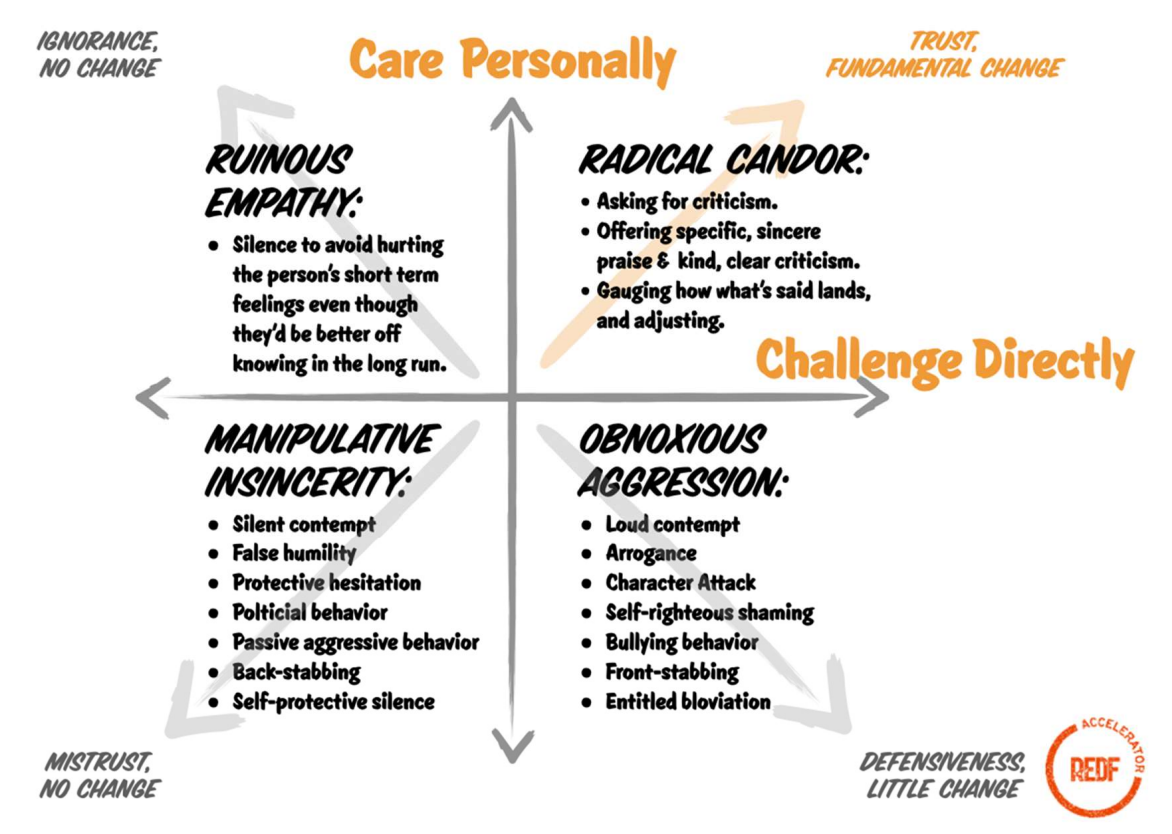
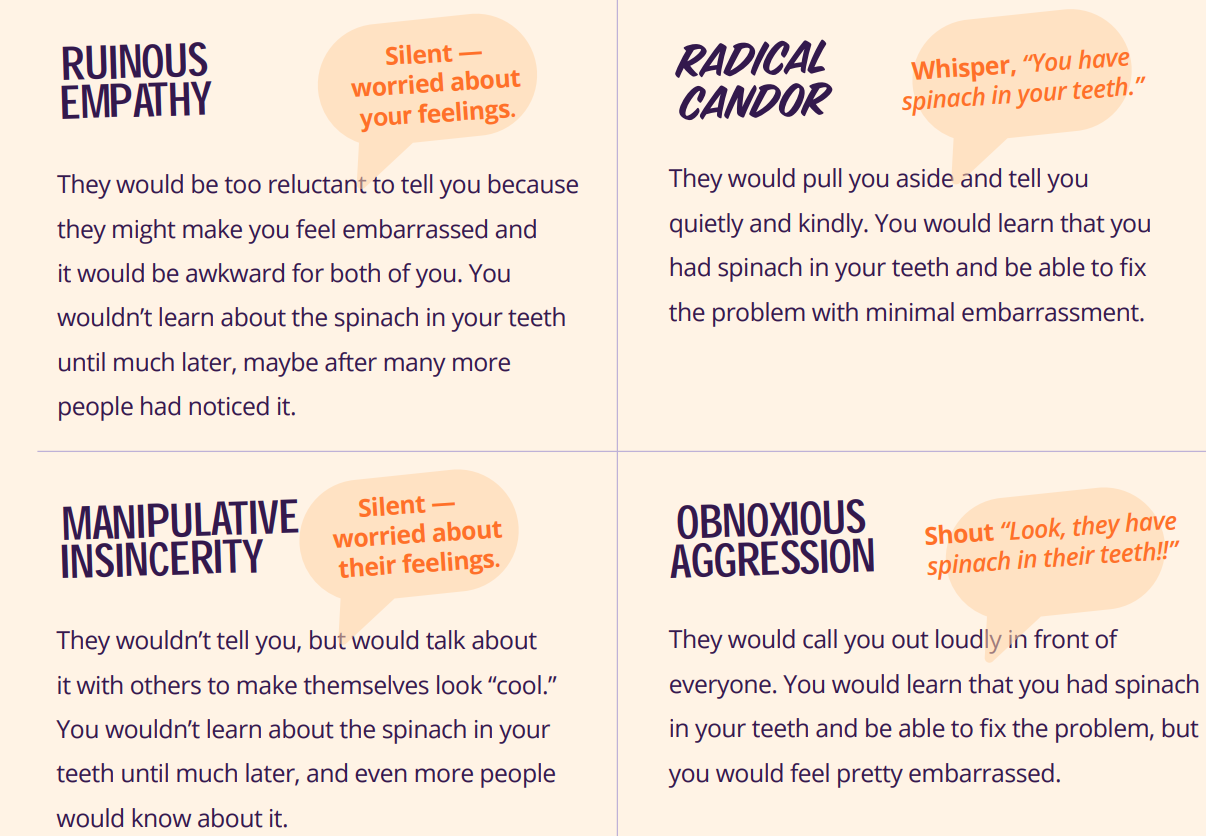
Most feedback fails in one of three ways. If it’s too blunt, the other person’s brain treats it like a social threat, and defensiveness kicks in before the message even lands. If it’s too vague, nothing really gets through at all, because the person giving the feedback starts softening or backtracking halfway through. And the feedback sandwich - where criticism is hidden between two compliments - has become so predictable that most people just wait for the middle part.
Feedback works best when both people see themselves as collaborators trying to solve a problem together, rather than opponents judging each other.
The four-part formula
Researchers who studied the most effective feedback givers found a consistent pattern. It's not about personality or courage — it's a repeatable structure that works because it respects how the brain processes information. Here are the four parts:
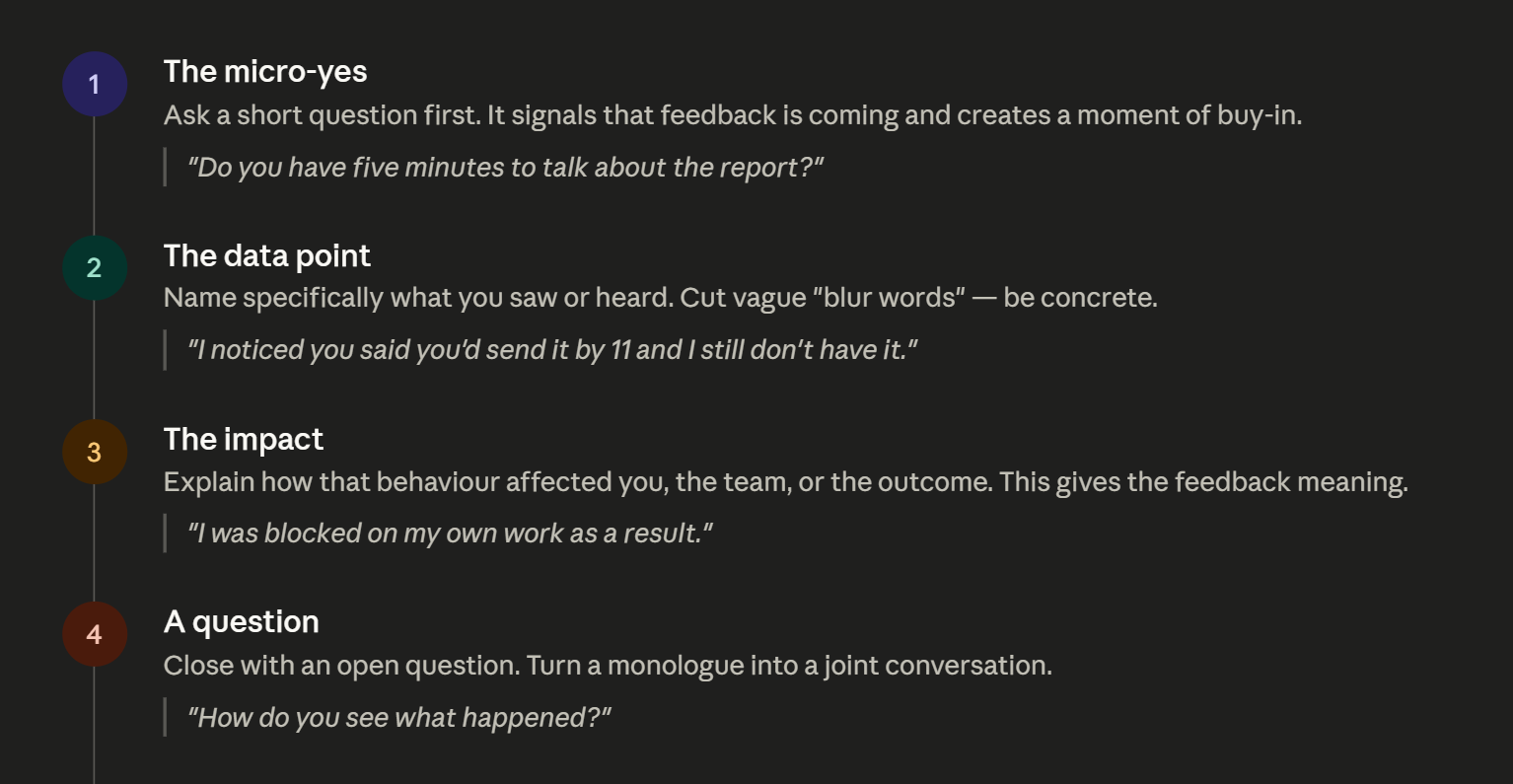
A quick example. Instead of: "You're not reliable." Try: "Do you have five minutes to talk about the report? [micro-yes] I noticed you said you'd send it by 11 and I still don't have it. [data point] I was blocked on my work as a result. [impact] How do you see what happened? [question]"
This structure works equally well for positive feedback. Specificity tells the person exactly what to keep doing, rather than leaving them with a vague feeling of having done something right.
The scenario
A colleague presented in a team meeting. They talked over others, cut off questions, and ran 15 minutes over time. The rest of the team looked frustrated. They seem unaware of how it landed. You work closely with them and want to say something — but you know they're proud of the work.
Give them feedback using the four-part formula.
Opening
- "Can I share something with you? I think it might be useful."
- "Do you have a few minutes? I wanted to talk through something I noticed."
- "I want to be honest with you — is now a good time?"
Naming the behaviour
- "What I observed was…"
- "In the meeting on Tuesday, I noticed that…"
- "This is specifically about… rather than a general pattern."
Stating the impact
- "The effect it had on me was…"
- "From the team's side, what happened was…"
- "The reason I'm raising it is because it affected the outcome."
Inviting response
- "How do you see it from your side?"
- "I could be missing context - what was going on for you?"
Before you say anything:
Even the best formula falls flat without preparation. Effective feedback givers spend real time thinking about what they want to say before the conversation. A few questions to work through in advance:
What are their goals? Feedback lands better when it's clearly connected to something the other person already cares about. If you know they want to improve their presentation skills, feedback on communication feels like help rather than criticism. Ask for two or three goals before giving feedback — it makes you safer to give honest input, and it focuses the conversation on areas where your input is actually welcome.
What's their self-assessment? If someone's self-assessment is purely positive, they may be seeking validation rather than feedback. If they've identified their own concerns, you have far more latitude to be honest.
What's your objective? The most important question of all — do you want to help this person improve and stay on the team? Or is this a final conversation that may lead to separation? Your answer completely changes the tone, structure, and specificity required.
Ask yourself before you start:
- What exactly did I observe — can I name one specific moment?
- What was the actual impact, and on whom?
- What do I want them to do differently — is that clear in my head?
- Am I still reacting emotionally, or am I calm enough to be useful?
- Is now the right moment, or should I wait for a better one?

 Mark Murphy