Have a read through the examples below, then have a go at the exercise linked at the bottom of the page.
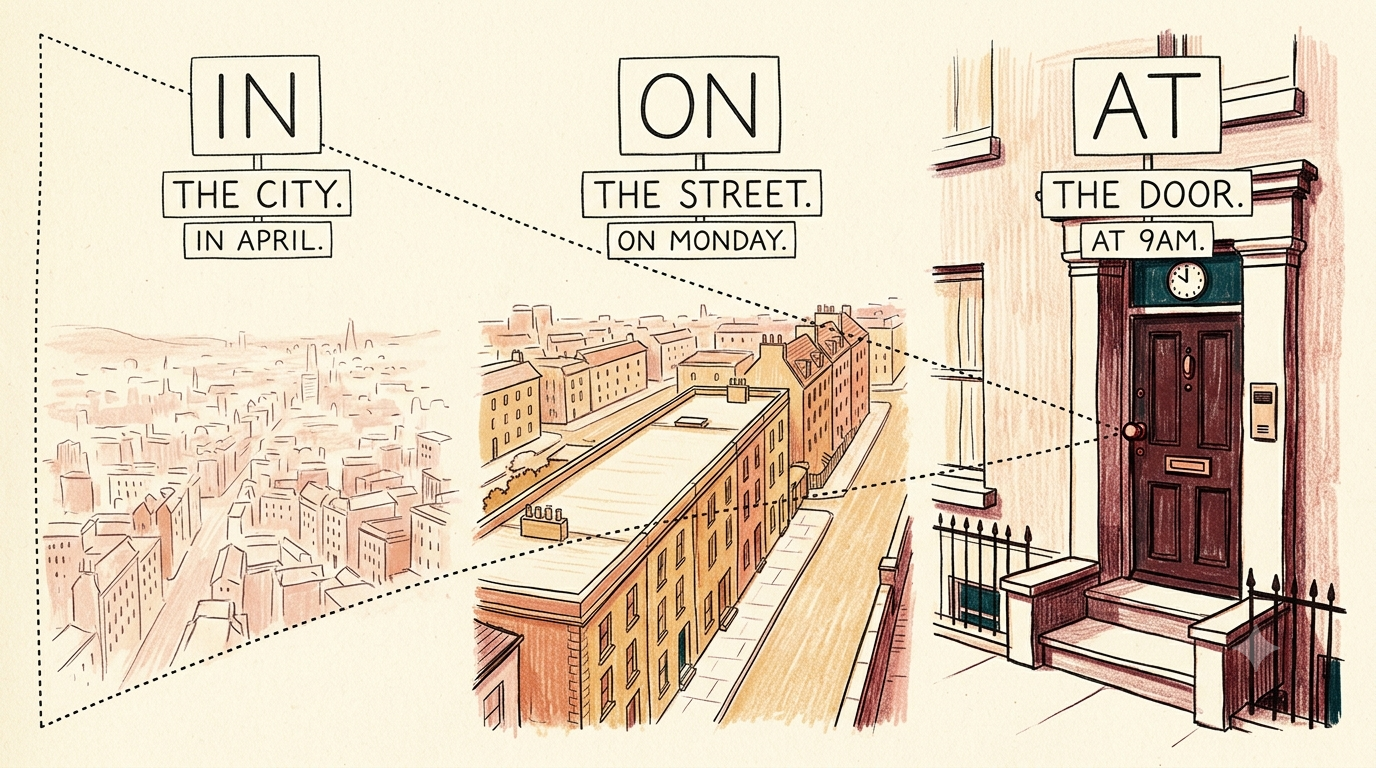
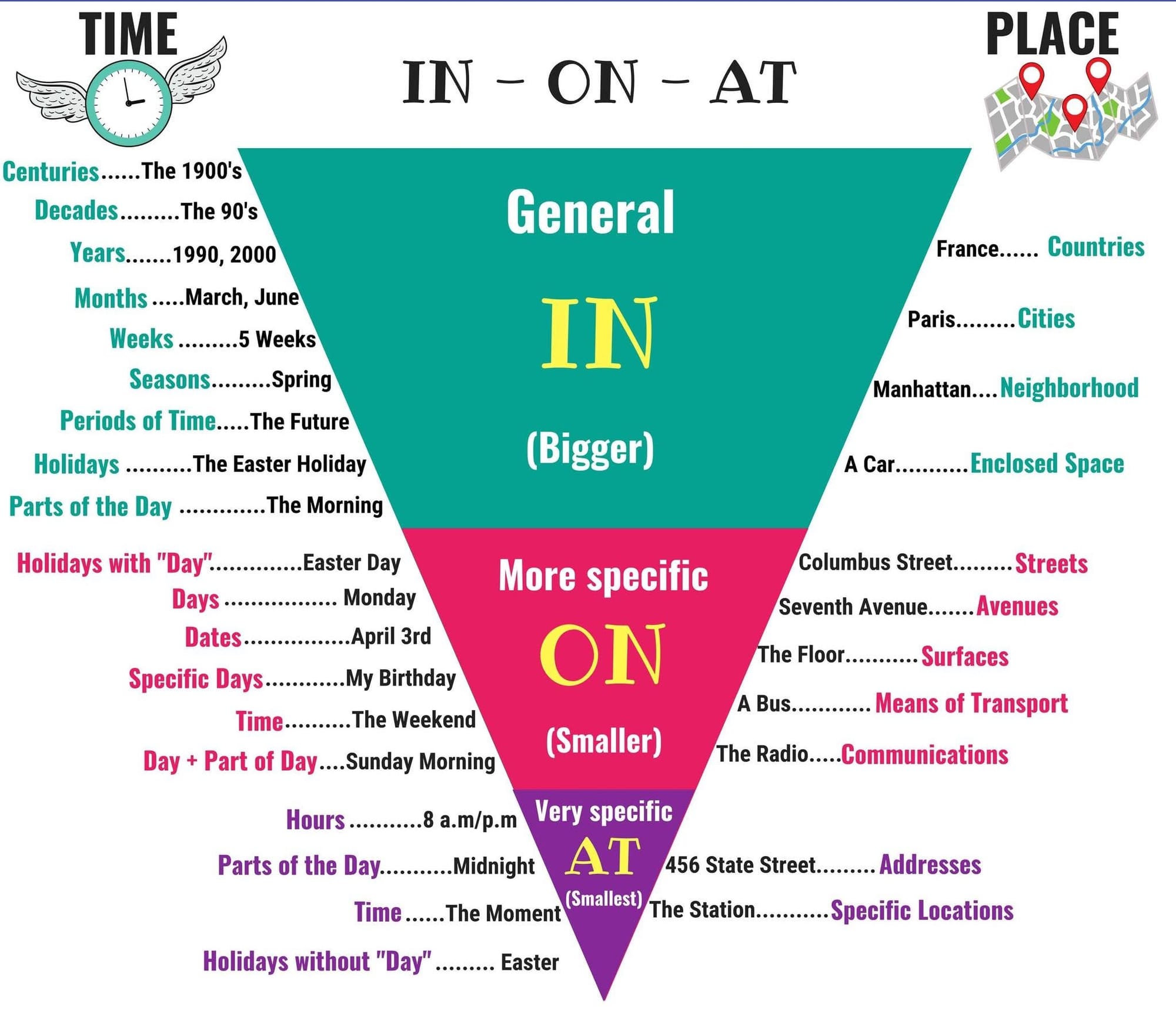
Three small words, in, on and at, cover almost all of time and place in English. The good news is that here, unlike with dependent prepositions, there is a real pattern to lean on. Think of them as zooming in: in is the widest view, on is closer, and at is a single point. Once you feel that, most of the choices start to make sense.
Time
The same zoom idea works for time. Long stretches take in, single days take on, and exact clock times take at.
inLong periods · Months · Years · Parts of the day
Use in for the big blocks of time you can picture yourself sitting inside: months, seasons, years, and the broad parts of a day.
in the morningI do my best work in the morning.
in AprilThe project launches in April.
in 2025She joined the company in 2025.
in summerWe are quieter in summer.
in an hourI will call you back in an hour.
in the 90sThe building went up in the 90s.
The one exception. It is in night → at night. Every other part of the day takes in, but night takes at.
onDays · Dates · Named days
Zoom in one level. Use on for a specific day or date. If you can point to it on a calendar as a single square, it takes on.
on MondayThe review is on Monday.
on 15 MayWe sign the contract on 15 May.
on my birthdayI took the day off on my birthday.
on Friday morningLet us meet on Friday morning.
on the weekendI rarely check email on the weekend.
on New Year's DayThe office is closed on New Year's Day.
Notice this pair. A part of the day is usually in (in the morning), but the moment you attach it to a specific day it becomes on: on Friday morning.
atClock times · Exact points
Zoom all the way in to a single point. Use at for exact clock times and a few fixed expressions that behave like precise moments.
at 9amThe call starts at 9am.
at noonWe break for lunch at noon.
at nightI do not answer messages at night.
at the weekendI switch off at the weekend.
at ChristmasThe team meets up at Christmas.
at the momentI am tied up at the moment.
British and American differ here. Britain says at the weekend, America says on the weekend. Both are correct. Pick whichever matches the English around you.
Place
The same zoom logic holds. In is an enclosed space you are inside, on is a surface you are touching, and at is a single point or address.
inEnclosed spaces · Areas
Use in when something sits inside a space with edges around it: a room, a building, a city, a country.
in the officeShe is in the office today.
in LondonOur clients are mostly in London.
in a meetingHe is in a meeting until three.
in the buildingReception is in the building next door.
in my inboxThe file is in my inbox.
in the carI left my badge in the car.
onSurfaces · Lines · Floors
Use on when something rests on a surface or sits along a line: a desk, a wall, a floor, a road.
on the deskYour notes are on the desk.
on the third floorWe are on the third floor.
on the wallThe whiteboard is on the wall.
on the agendaThat point is on the agenda.
on the coastThe retreat is on the coast.
on page 4The figures are on page 4.
The street: it depends who you ask. Britain says in the street, America and Australia say on the street. Both are natural. For an address with a number, everyone uses on: on King Street.
atPoints · Addresses · Activities
Zoom in to a single point: an exact address, or a place thought of as a spot where something happens rather than a space you are inside.
at the stationI will meet you at the station.
at workShe is at work right now.
at the topHis name is at the top of the list.
at 10 King StreetThe office is at 10 King Street.
at the conferenceWe first met at the conference.
at the doorThere is someone at the door.
In vs at, the useful difference.in the office pictures the space around you; at the office pictures it as a point on a map, often as where you are rather than where you are sitting. Both are correct, and the choice is about what you want to stress.
The transport rule: on or in?
This one confuses almost everyone, but there is a clean logic to it. It comes down to a simple question: can you stand up and walk around inside it?
on
Big enough to stand up and walk around in.
on the bus
on the train
on the plane
on a ship
on a bike / a horse
in
Small, you sit down and stay put.
in the car
in a taxi
in a van
in a small boat
in a helicopter
The odd ones out. A bike and a horse take on even though you cannot walk around on them, because you sit on top rather than inside. And the rule bends a little: some people say in the taxi and on the taxi in casual speech, but in is the safe choice for anything car-sized.