Job Interview Prep


On this page you’ll find some key vocabulary relating to job interviews, plus some discussion on how to approach different questions.
Vocabulary
First, let’s cover the most important vocabulary when it comes to landing a new job.
▼ The process of getting a job from A to Z
When you decide to apply for a job, the first step is completing an application. This might involve filling out an online form, uploading documents, or answering specific questions about your experience. These days you might even get the pleasure of recording a video of yourself to send in… or perhaps you’ll be interviewed by an AI agent. Thrilling!
You will usually need to submit your CV (or resume if you’re speaking American English), along with a cover letter that introduces who you are and explains why you are a good fit for the role. Employers may also ask for references, which are people who can recommend you and speak about your previous work.
After you submit your application, the employer will review it and decide whether to shortlist you. If you are shortlisted, you will be invited to an interview, which could take place over the phone, via video call, or in person. At this stage, the company is assessing your skills, experience, and overall fit, while you also have the opportunity to learn more about the role, the team, and the company culture. It’s quite common for employers to begin with a short, informal interview, often around 10–15 minutes. This is sometimes referred to as a “vibe check” a quick way for them to see if your personality aligns with the company, assess how you communicate, and confirm that you are who you say you are.
If you progress beyond the initial interview, you will usually go through one or more additional rounds. These interviews tend to be more in-depth and may include technical questions, competency-based questions, or task-based assessments. You might be asked to complete a case study, give a presentation, or demonstrate specific skills related to the role. At this stage, you may also meet different members of the team, including your potential manager or senior leaders, as the company builds a clearer picture of your abilities, your culture-fit, and how well you would fit into the organisation.
If everything goes well and you meet the employer’s expectations, you may receive a job offer. At this point, you can accept the offer (say yes), decline it, reject it or say no (turn it down), or even make a counteroffer if you want to negotiate your salary, benefits, or working conditions. Once both sides agree, you will go through the onboarding process, where you complete any final paperwork and begin your new role.
| Vocabulary | Definition |
|---|---|
| application / apply for | A formal request for a job |
| fill out / complete | To write required information on a form / to finish something |
| submit / send off | To send something officially |
| CV / resume | A document showing your experience, skills, and education |
| cover letter | A letter explaining why you are suitable for the job |
| references | People who can recommend you |
| formal | Professional and polite |
| informal | Relaxed and casual |
| small talk | Light, general conversation |
| interview rounds | The different stages of interviews |
| at this stage | At this point in the process |
| offer | A job proposal |
| accept | To say yes |
| decline / reject | To turn down / to say no |
| counteroffer | A new offer with different terms |
| negotiation | A discussion to reach agreement |
| onboarding | The process of starting a new job |
| break the ice | To start a conversation and make people feel comfortable |
Questions
Before we dive into some questions, let's consider what the interviewer already knows about you at this stage.
If you've been invited to an interview, they already know your name, they have an overview of your professional experience and education, as well as any other skills or hobbies included on your CV. The interview is an opportunity to provide additional information about yourself, experiences and show off just how charming you are.
Most candidates rely on luck in interviews, but what looks like luck is usually just preparation. The people who get shortlisted are the ones who prepare properly, especially for common questions that are almost guaranteed to come up. One of the biggest mistakes candidates make is trying to “wing it,” particularly with the first question: “Tell me about yourself.” This question sets the tone for the entire interview, so having a strong, prepared answer is essential.
If you were to walk up to the average person and ask them to "Tell me about yourself", they may start with their name, age, birthplace, profession... But, we understand that you have to be above average to get a job these days.
Tell me about yourself
How to answer this question better than the average person?
Start with structure.
Most candidates struggle because they either say too much or focus on things that aren’t relevant. A clear, structured answer helps you stay focused and makes it easy for the interviewer to follow.
A simple approach is to move through three stages: your background, your experience, and your direction. You briefly explain where you started, what you’ve done, and what you’re looking for next. This approach is effective because it shows clarity, self-awareness, and professionalism, while also allowing you to tailor your answer directly to the job.
There's arguably nothing wrong with this structure, it tells them a little about you. It's formal, structured and relevant.
Short answer:
"I studied chemistry at Colgate University, and I’ve been working for Smith Pharmaceuticals for the last three years. My experience is mainly in the area of clinical testing, but I’m very interested in the field of cancer research."
Longer answer:
"I studied marketing at university and developed a strong interest in consumer behaviour and branding. After graduating, I worked for two years at a digital marketing agency, where I focused on social media campaigns and content strategy. During that time, I worked with a range of clients and developed strong communication and problem-solving skills.
More recently, I’ve been working in an in-house marketing role, where I’ve taken on more responsibility for planning campaigns and analysing performance. I’ve particularly enjoyed working on projects that involve creativity and data, and I’ve helped improve engagement across several platforms.
At the moment, I’m looking for an opportunity where I can continue to grow and take on new challenges, which is why this role really stood out to me. I’m especially interested in your company because of your focus on innovation and long-term development."
How to answer this question better than most
Honestly, answering in that way feels like a missed opportunity. It lacks personality, doesn’t show your motivations or how you think, and gives very little sense of how you communicate or tell a story.
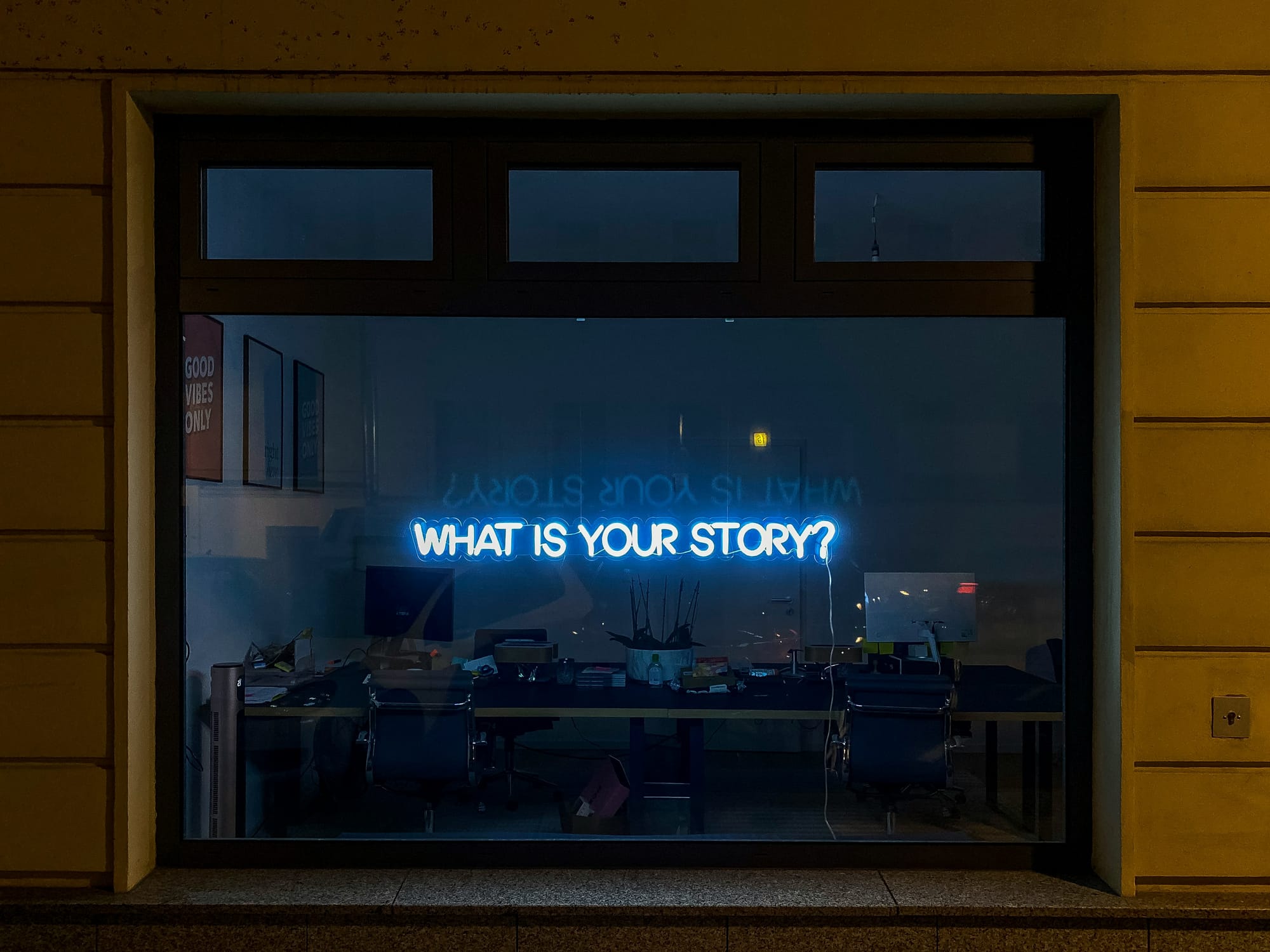
Instead of listing qualities or achievements, using a short, well-placed story helps bring your answer to life. A good story shows your personality, builds rapport, and makes you more memorable. It also creates a more natural connection with the interviewer. When done well, it shifts the interview from a formal question-and-answer session into something that feels more like a conversation.
The most effective approach is to carefully combine both.
A purely structured answer can feel a little dry and predictable. On the other hand, a full “origin story” can sometimes feel forced or unnatural. You don’t need to dramatically rewind to childhood or tell a long, theatrical story.
You still follow a clear structure: your background, your experience, and your direction. But instead of listing facts, you present them as a natural progression. You briefly take the interviewer back to where your interest began, and then guide them through the key decisions and steps that brought you to where you are today.
As you do this, focus on explaining why.
- Why you chose a certain path.
- Why you changed direction.
- How your role evolved over time.
This is what turns a structured answer into a story. It allows the interviewer to understand not just what you’ve done, but how you think and what motivates you.
Here's my attempt at this...
I became an English tutor almost a decade ago. I loved the job from the beginning because I was working directly with people from all over the world, each with different goals, backgrounds, and challenges. Quite quickly, I realised the job was less about teaching English in a traditional sense, and more about connecting with individuals and supporting them with the specific difficulties they were facing.
This job motivated me to return to university to get my masters in Psychology and qualifications in counselling. I wanted to understand how people think, understand their challenges in greater depth.
Since then, my work has naturally evolved into communication coaching. I now help people not just with their English, but with how they present themselves in interviews, meetings, and everyday professional situations. At this point, I’m looking to continue developing in this area, which is why this role stood out to me. It aligns closely with both my experience and what I’m genuinely interested in.
I tried to demonstrate the following:
- Why I'm passionate about my job
- The reasons why I went back to uni
- Provide a sense of direction until the present moment.
Here's a list of phrases that could help you incorporate a sense of story and progress to your answer:
- “Over time, I started to notice that…”
- “That’s when I realised…”
- “At that point, I decided to…”
- “That experience led me to…”
- “From there, I moved into…”
- “Since then, I’ve focused on…”
- “More recently, I’ve been working on…”
Key tenses to use for this question:
Past Simple (for completed actions)
Use the past tense to talk about things that started and finished in the past.
Example: I studied marketing at university.
Present perfect (for past to present)
Use the present perfect for experiences that started in the past and continue now, or are still relevant.
Example: I’ve worked in marketing for three years.
Present Continuous (for current situation)
Use the present tense to describe your current role, situation, or goals.
Example: I’m currently working in an in-house marketing role and I’m looking to develop further.
Strengths and weaknesses
This question(s) comes up in almost every interview, and it’s one that many candidates get wrong. Most people either list a few generic strengths with no real evidence, or they choose a weakness that feels dishonest or poorly thought out. In reality, this question is designed to assess two things: your self-awareness, and your ability to reflect on your own performance. A strong answer should feel considered, relevant, and grounded in real experience.
When talking about your strengths, avoid simply listing qualities. Anyone can say they are hardworking, organised, or a good communicator. The key is to connect your strengths to the role and briefly show how they appear in practice. Focus on a small number of strengths that are genuinely relevant, such as work ethic, adaptability, problem-solving, collaboration, attention to detail, time management, or leadership. Then support them with a short example or explanation. This helps the interviewer understand not just what you claim, but how you actually work.
When it comes to weaknesses, the goal is not to undermine yourself, but to demonstrate honesty and growth. Choose something real, but not critical to the role, and show that you are actively working to improve it. Good examples include struggling to delegate, limited experience with public speaking, difficulty giving direct feedback, impatience with slow progress, or taking on too much work. The important part is the second half of your answer, explaining what you’re doing to improve. This shows maturity, self-awareness, and a willingness to develop, which is often more valuable than the weakness itself.
I'll have a go at answering this question...
Ultimately, I'm good with people. My biggest strength is my ability to create a supportive and relaxed environment, in which people feel comfortable enough to think, reflect, make mistakes... One thing comes very easy to me that others find difficult, and that's patience. I've been told a few times that I have endless patience, which in my job is usually a good thing.
I'm highly curious and motivated to help people, which probably links to a weakness of mine... I can sometimes be a bit of a people pleaser, and I have a tendency to go above and beyond for others. While that can be a positive in terms of commitment and support, it can also mean I take on too much or don’t always set clear boundaries.
It’s something I’ve become more aware of, and I’ve been working on managing my time and priorities more effectively, making sure I’m still supportive while also being more structured and balanced in how I work.