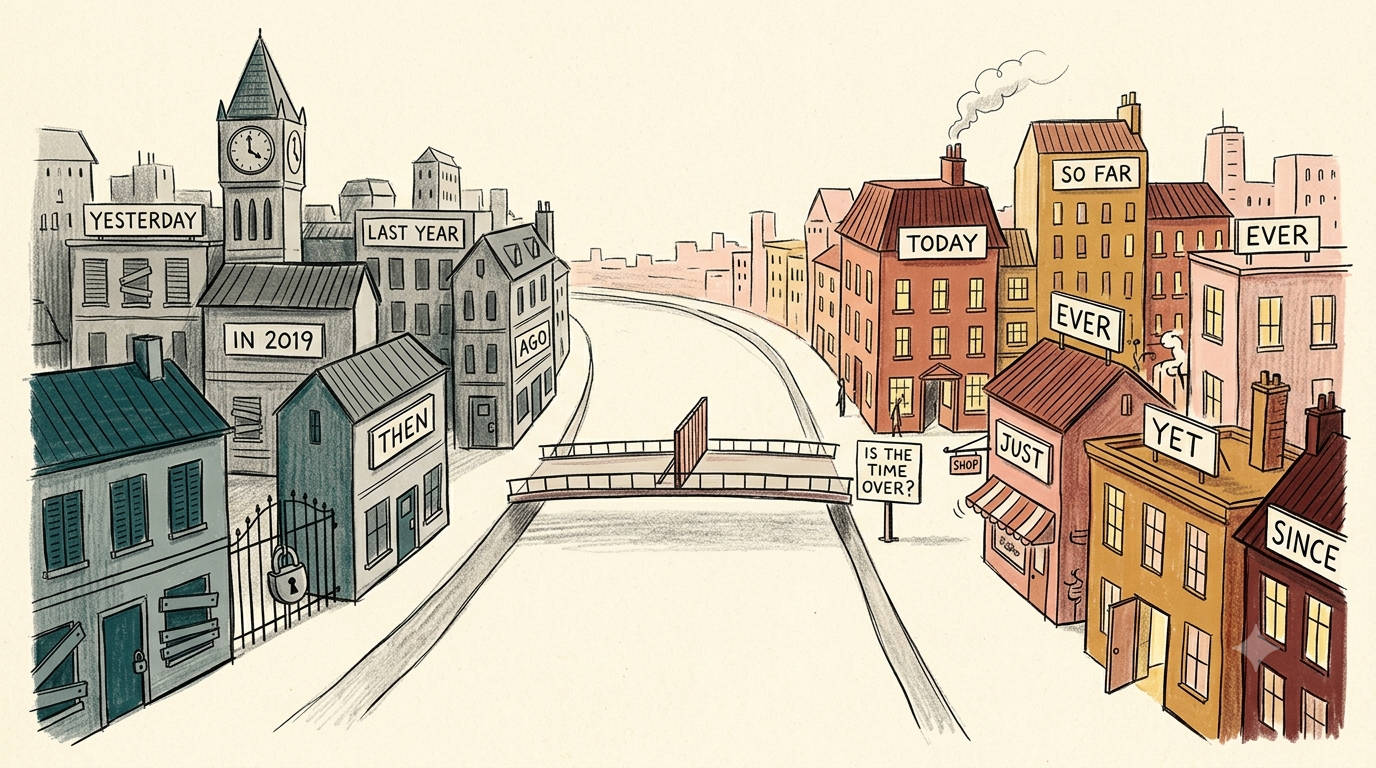
Have a read through the examples below, then have a go at the exercise linked at the bottom of the page.
This one gives people away more than almost anything else, and it is not because the forms are difficult. Most languages simply do not cut up the past the way English does, so the choice can feel invisible. The difference itself is fairly small once you see it.
The difference
English is not asking whether the action is finished. Both tenses describe things that are already done. What matters is whether the time period you are talking about has finished.
Finished and gone (yesterday, last summer, in 2019) gives you the past simple. Still running (today, this week, your life so far) gives you the present perfect.
Past Simple
The time is finished and gone.
I lost my keys on Tuesday.
She lived in Berlin for a year.
We ate at that place last month.
He called me back straight away.
Present Perfect
The time still reaches to now.
I have lost my keys.
She has lived in four countries.
We have eaten there twice.
He has not called me back.
Same event, different message
This is where it gets interesting. The thing that happened can be identical, and swapping the tense still changes what the other person hears. It is not a technicality. It changes the meaning.
I lost my wedding ring.
Something that happened. Perhaps it turned up again. The story is over.
I have lost my wedding ring.
It is gone right now, and that is the problem. My wife is going to kill me.
The fridge broke last week.
It happened, and it is filed away. Maybe it is fixed by now.
The fridge has broken.
It is broken as we speak, and the milk is going warm.
She worked at Google.
She does not anymore. That chapter is shut.
She has worked at Google.
It is part of her story, part of what she brings. She might still be there.
I didn't shave this morning.
The morning is over. It did not happen and now it cannot.
I haven't shaved this morning.
It is still morning. There is time yet.
Did you eat?
Asking about a particular occasion. Did you get anything at the party?
Have you eaten?
Asking about now. Are you hungry? Shall I make you something?
What the present perfect is actually for
In practice it does four jobs. Recognising which one you are doing usually settles the choice.
oneLife experience · Have you ever?
What you have done at some point, without saying when. The experience is the interesting part, not the date. A life is still running, so the window is open.
Have you ever been to Japan?No, I have never been.
She has run two marathons.Twice, and she says never again.
I have fallen in love twice.Both times were a disaster.
He has managed teams before.You can tell from how he runs a room.
The moment you say when, it flips.I have been to Japan becomes I went to Japan in 2019. Naming the date shuts the window.
twoStarted before, still true now
Something began earlier and has not stopped. This is the one people get wrong most, because the past simple quietly suggests it is over.
I have lived here for six years.And I am not moving.
We have been together since 2020.Still going strong.
She has known him since school.They go back a long way.
I have had this car for years.It is held together with hope.
This one really matters.I have worked here for three years means you still do. I worked here for three years means you have left. Same three years, completely different news.
threeRecent news · It matters right now
Something happened and the result is sitting right in front of you. You are not really talking about the past at all. You are talking about the mess it left behind.
I have cut my finger.It is bleeding. Pass me a plaster.
She has resigned.Everyone found out this morning.
They have cancelled the flight.So we are stuck here until Monday.
He has just left.You have missed him by a minute.
fourHow long? · For and since
Asking or saying how long something has been going on, when it is still going on.
How long have you known her?Since we were children.
We have been married for ten years.Ten good ones, mostly.
I have had this cough for a week.It will not shift.
She has run the team since March.And it shows.
For or since? Use for with a length of time (for six months, for years) and since with a starting point (since March, since I left school). If the thing is genuinely finished, the question goes back to the past simple: How long did you live there?
The words that give it away
Some time expressions belong to one tense or the other. These are worth learning, because the time word usually settles the question for you.
closedThese pull the Past Simple
yesterdayI saw her yesterday.
last week / month / yearWe moved in last summer.
in 2019They got married in 2019.
agoHe left about ten minutes ago.
when I was...I broke my arm when I was nine.
thenThings were different then.
openThese pull the Present Perfect
alreadyWe have already seen it. Twice.
yetHe has not asked me out yet.
justI have just got in.
ever / neverI have never been on a plane.
so farSo far, so good.
today / this weekI have not stopped all day.
sinceI have not slept properly since Tuesday.
forWe have known each other for years.
Just, already and yet.Just and already live mostly in positive sentences, and yet lives in negatives and questions. I have just seen him. She has already left. They have not decided yet. Have you eaten yet?
Three tricks to hold on to
Trick one: if you can name the day, use the past simple.The second a finished time appears, the present perfect is out.
So I have seen him yesterday does not work. Yesterday is finished.
Trick two: does it still matter?If the past thing has left a mark on right now, go with the present perfect.I have broken my glasses means I cannot see. I broke my glasses is just something that happened once.
Trick three: announce, then explain.Break the news in the present perfect, then tell the story in the past simple.
This is what native speakers do without noticing. She has resigned. She told the board on Tuesday and cleared her desk the same afternoon.
The mistakes that keep coming back
These come back again and again, and almost always because the first language is quietly steering.
The present perfect with a finished time.I have seen him yesterday → I saw him yesterday. German, French, Italian and Spanish all use their perfect form for ordinary past events, so this one walks straight into English.
The past simple when it is not over.I live here for six years → I have lived here for six years. And be careful with I lived here for six years, which tells people you have moved out.
The experience question.Did you ever live abroad? → Have you ever lived abroad? Someone's life is still running, so experience questions take the present perfect.
The American habit. You will hear Did you eat yet? and I already sent it in American English, where British English would use the present perfect. Both are accepted these days. If you are working with British or Australian colleagues, the present perfect is the safer bet.