Receiving Feedback


- Do you enjoy receiving feedback, or does it make you uncomfortable?
- Can you think of a time someone gave you feedback that stung — even if they meant well?
- Do you react differently depending on who gives you the feedback?
- Have you ever received feedback you completely disagreed with? What did you do?
Why do we get defensive?
When feedback contradicts how we see ourselves, our brain treats it like a physical threat. Your heart rate rises, your thinking narrows, and your instinct is to fight back or shut down.
This is called cognitive dissonance - the stress your brain feels when new information doesn't match your existing beliefs.
The problem is that when cognitive dissonance kicks in, we stop listening and start defending. And that's when feedback stops being useful.
In general we will try to reduce this mental stress — cognitive dissonance — in one of four ways.
1. Change your behaviour to conform — “Thanks for the feedback, I’m going to take it on board and do it differently next time.”
2. Alter the perception of the conflicting information — “Yes, but that was a one-time thing.”
3. Justify your behaviour by adding a new belief — “That’s not what everyone else thought.”
4. Ignore or deny the conflicting information — “I don’t believe you, you don’t know what you are talking about.”
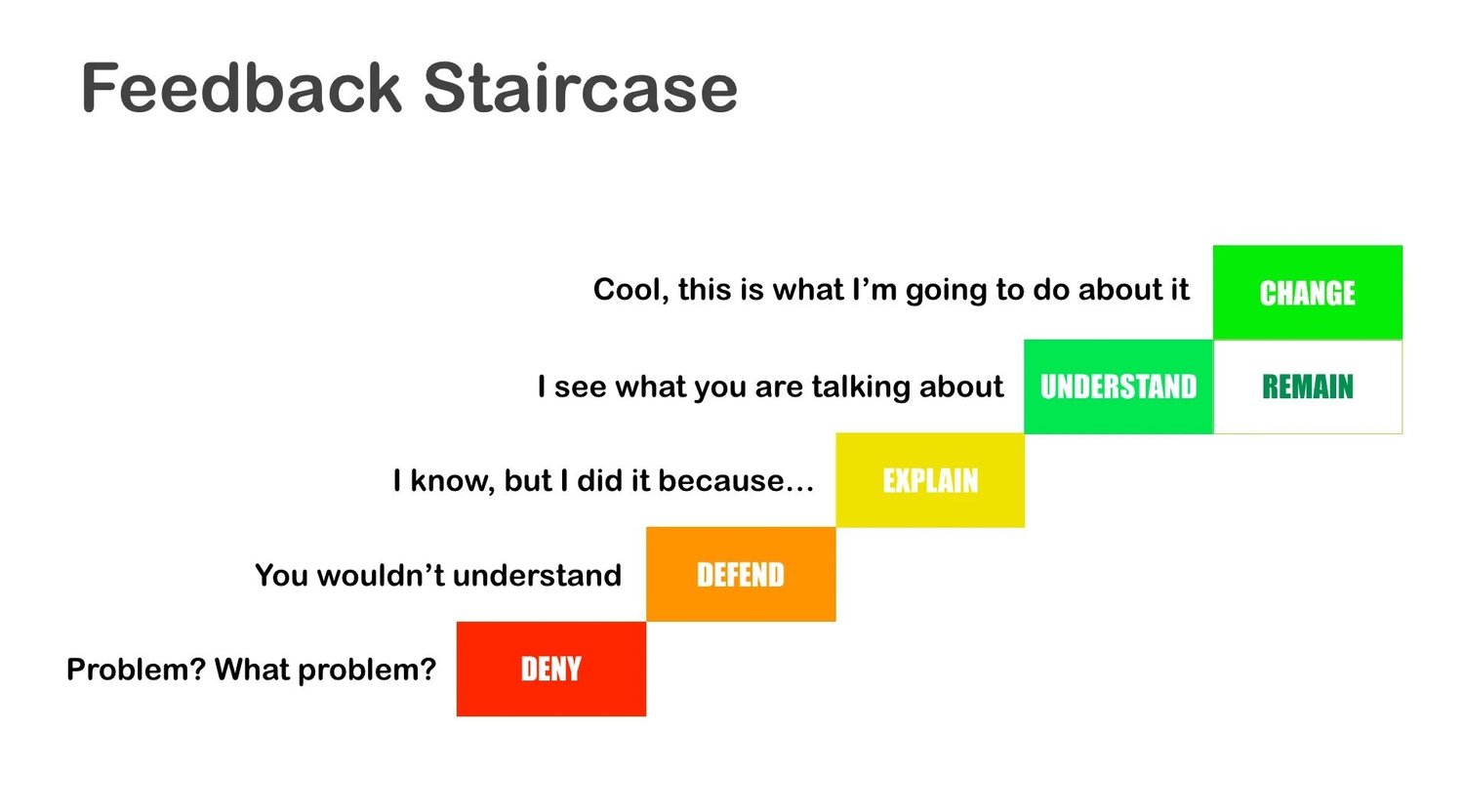
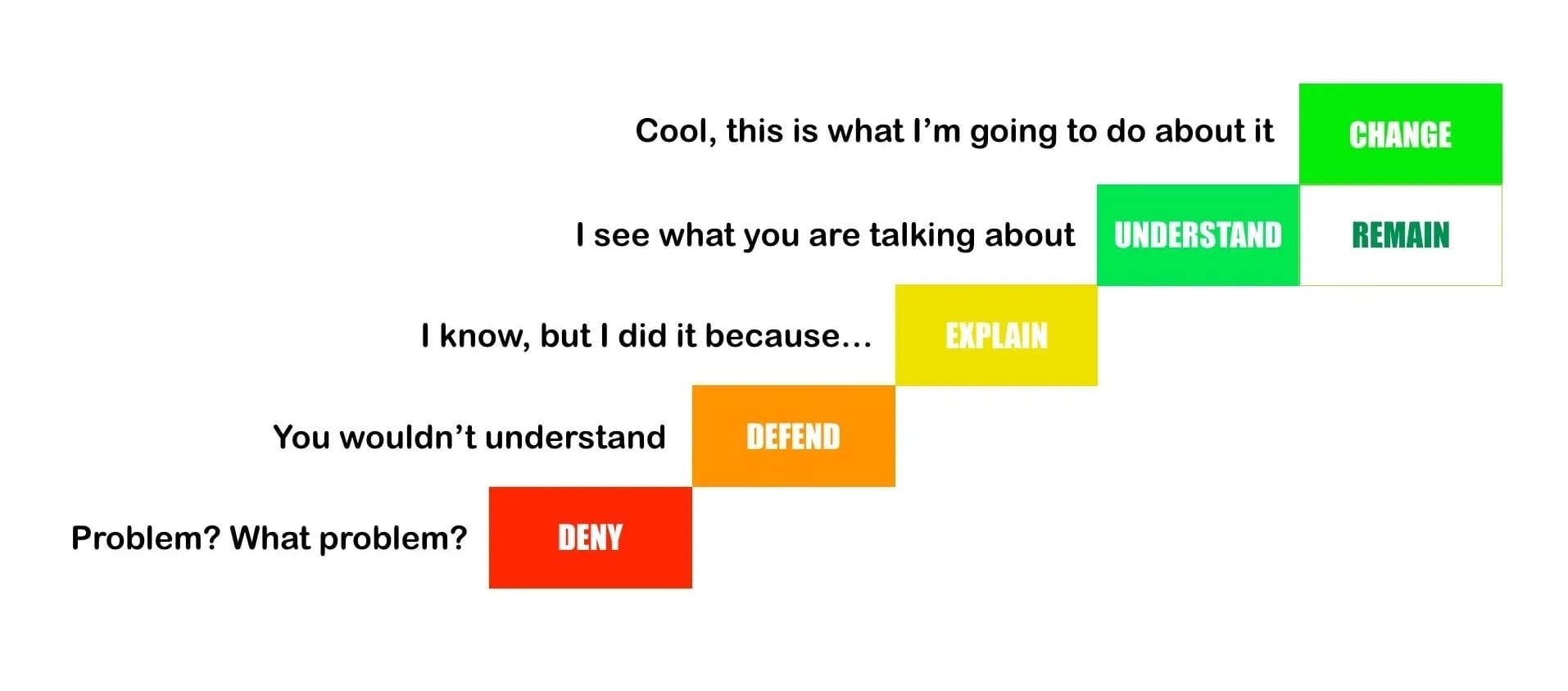
The Feedback Staircase
When we receive feedback, we don't jump straight to understanding — we move through a series of natural emotional stages first. Most people start at the bottom and work their way up.
The key is not to skip the steps, but to notice where you are — and consciously move one step higher.
Which step do you usually get stuck on?
Vocabulary
Perspective
A particular way of seeing or interpreting a situation
• Point of View
• Angle
• From where I'm standing...
Acknowledge
To show that you have heard and understood something, even if you disagree.
• I see what you mean
• I recognise that
• I see where you're coming from
Pushback
Politely disagreeing with or challenging something you've been told
Defensive
Reacting to criticism by protecting yourself rather than listening
Constructive Feedback
Feedback or criticism that is meant to help you improve
Cognitive Dissonance
The mental discomfort of holding two conflicting ideas at once
Receiving Feedback You Disagree With
Situation
Your manager has just given you your quarterly review. The feedback is unexpected - they've criticised something you're actually proud of. You think they've misunderstood your work, or they simply have it wrong.
Respond professionally, without being defensive or dismissive.
Useful Phrases
"I appreciate you raising that — can I share my perspective on it?"
Buys you time without shutting down
"That's not quite how I saw it, but I'd like to understand your thinking"
Pushes back without being aggressive
"I hear what you're saying - I'd like to revisit this once I've had time to reflect" - professional, calm, leaves the door open
How Are You Responding?
Ask yourself these questions as the feedback lands:
- Do I fully understand what they're saying, or am I reacting too quickly?
- Where am I on the staircase right now - Denying? Defending? Explaining?
- Is there any truth in this, even if I disagree with how it was delivered?
- Am I defending the work, or defending my ego?
- Is this the right moment to push back, or should I sleep on it first?
If you're at DENY or DEFEND — slow down before you speak
- "Can I take a moment to make sure I've understood you correctly?"
- "I wasn't expecting that — can you help me understand what you observed?"
If you're at EXPLAIN — get curious instead of justifying
- "That's interesting — can you give me a specific example?"
- "Help me understand what you were seeing from your side"
If you're at UNDERSTAND — push back without aggression
- "I appreciate you raising that — can I share my perspective on it?"
- "I can see why it might have come across that way, though I experienced it differently"
If you're ready to CLOSE — end it professionally
- "I'd like to revisit this once I've had time to reflect"
- "I'll think this through and come back to you"
Three things worth holding onto:
Hold both views. Listen to the feedback and sit with it before you respond. You don't have to agree or disagree immediately — just hold both perspectives at the same time and let the initial reaction pass.
You don't always have to be ready. If you've had a bad day, you're stressed, or the feedback has caught you completely off guard — it's okay to say "This is important to me. Can we come back to this tomorrow?"
Remain is always an option. Feedback is one person's perspective. It isn't fact. Once you've genuinely processed it, you're allowed to decide it doesn't apply — and that's not the same as being defensive. That's judgment.
As Viktor Frankl put it: "Between stimulus and response there is a space. In that space is our power to choose our response."
 Ant Murphy