Tenses

Most learners start with the present simple and past simple, and these two tenses will take you a long way — the present simple alone makes up around 50% of all spoken and written English. But the other tenses open up a whole new level of precision and expression.
The present perfect lets you connect a past event directly to the present moment. The continuous tenses let you show that an action was in progress, not just that it occurred. The perfect continuous lets you convey how long something has been building. Each one gives you a more specific, more expressive way to place events in time. This lesson will walk you through all twelve.
Present Simple
I wake up at 6am every day.
Present Continuous
I’m talking to my friend right now.
Past Simple
We visited London last summer.
Past Continuous
I was reading when the phone rang.
Present Perfect
I’ve never seen snow in April before.
Present Perfect Continuous
She’s been studying for three hours.
Past Perfect
They had already left before we arrived.
Past Perfect Continuous
He had been working all night, so he was exhausted.
Future Simple (will)
I’ll call you tomorrow.
Be Going To
We’re going to move to a new apartment next month.
Future Continuous
This time tomorrow, I’ll be flying to London.
Future Perfect
By next year, she’ll have finished her degree.
Future Perfect Continuous
By June, I’ll have been teaching for ten years.
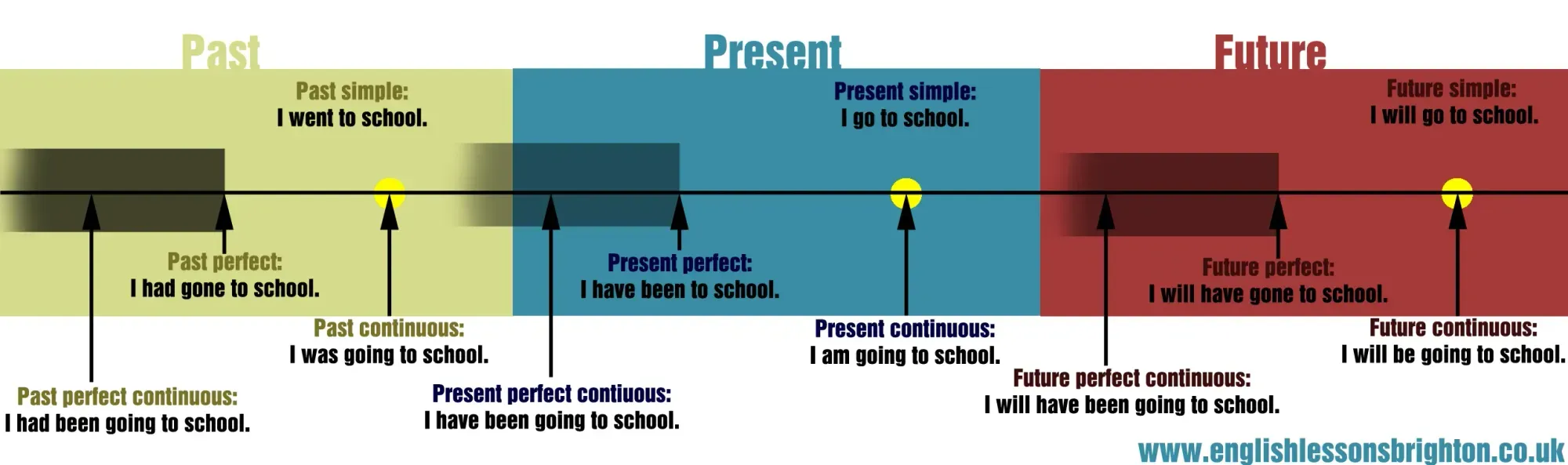
| Present | Past | Future |
|---|---|---|
| Present Simple | Past Simple | Future Simple |
| Present Continuous | Past Continuous | Future Continuous |
| Present Perfect | Past Perfect | Future Perfect |
| Present Perfect Continuous | Past Perfect Continuous | Future Perfect Continuous |
Stage 1 - The Basic Tenses
These four tenses are the building blocks of English. Master these and you will be able to talk about facts, habits, finished events, things happening right now, and plans for the future. Everything else builds on top of them.
Present simple
The present simple is the tense of facts, habits, and things that don't change. If something is reliably, repeatedly, or permanently true, this is the tense you reach for.
- Facts and general truths: Water boils at 100°C.
- Habits and routines: She drinks coffee every morning.
- Schedules and timetables: The train leaves at 8pm.
- Things that are always true about a person: He works in finance. She speaks three languages.
I wake up at 7am every day. My sister lives in Madrid. The museum opens at 10am.
Now your turn
Where do you live?
What's something you do everyday?
Past simple
The past simple is the tense of finished events. If something started in the past and ended in the past, this is the tense you use — it is as direct and straightforward as it sounds.
- A single completed action: She left at 6pm.
- A series of completed actions: I finished dinner, loaded the dishwasher and went to bed.
- A past habit or repeated action: He played football every Sunday as a kid.
- A past state: They lived in Berlin for six years.
Examples in context
I visited my grandmother last weekend. She studied law at university. We watched a film and ordered pizza.
Now your turn
What did you do yesterday?
What was true about you in the past but is not true now?
Present continuous
The present continuous describes what is happening right now, or a situation that is temporary rather than permanent. It is formed with am/is/are + verb-ing.
- Actions happening at this moment: I am writing an email.
- Temporary situations: He is living in Warsaw this year.
- Arrangements with another person: We are meeting on Friday.
- Trends and changing situations: Prices are rising.
Examples in context
She is studying for her exams this week. They are renovating the house at the moment. I am learning to cook. We are going on holiday next week.
Now your turn
What are you doing right now?
What are you working on at the moment?
What are you planning to do this weekend, or this summer?
Future simple
The future simple is the most direct way to talk about the future. It is formed with will + base verb and covers everything from firm predictions to promises made on the spot.
- Predictions about the future: It will rain tomorrow.
- Decisions made at the moment of speaking: I'll have the soup.
- Promises and offers: I'll help you carry those boxes.
- Facts about the future: She will be 40 next year.
Examples in context
I think it will be a warm summer. Don't worry, I'll call you when I arrive. He will start his new job in January.
Now your turn
What will do you this weekend?
Tell one fact about your future.
Make one prediction about the future.

Stage 2 — Building Up
You can already talk about the present, the past, and the future. These next four tenses add depth to that — they let you describe actions that were in progress, connect the past to the present, and talk about the future with more precision.
Past continuous
The past continuous describes an action that was in progress at a particular moment in the past. It is formed with was/were + verb-ing, and it almost always provides context or background for something else.
- An action in progress at a specific past time: At 7pm, I was cooking dinner.
- Background context for another event: It was snowing when we arrived.
- An ongoing action interrupted by another: I was watching a film when the phone rang.
- Two actions happening simultaneously: She was reading while he was cooking.
Examples in context
I was walking to work when I ran into an old friend. They were living in Paris when they got engaged. It was raining all morning, so we stayed inside.
Now your turn
What were you doing at this time yesterday?
Was anything happening around you — the weather, other people?
Did anything interrupt you?
Future continuous
The future continuous describes an action that will be in progress at a specific point in the future. It is formed with will be + verb-ing and suggests the action will have length, not just occur in an instant.
- An action in progress at a future moment: At noon tomorrow, I will be sitting on a plane.
- An action that will continue over a period of time: They will be travelling all summer.
- A polite way to ask about someone's plans: Will you be joining us for dinner?
- Two future actions happening at the same time: While you sleep, the team will be working.
Examples in context
This time next week, I will be lying on a beach. She will be studying all weekend before her exam. While you are at the meeting, I will be finishing the report.
Now your turn
What will you be doing this time tomorrow?
What about this time next year?
Present perfect
The present perfect connects the past to the present — it tells us about past events that are still relevant now. It is formed with have/has + past participle.
- Experiences up to now: I have never been to Japan.
- Actions with a result in the present: I have lost my keys (so I can't get in).
- Actions that started in the past and continue now: She has lived here for ten years.
- Recent events: He has just left the office.
Examples in context
I have visited twelve countries. She has worked at the company since 2018. We have just finished dinner.
Now your turn
What is something you have never done but would like to?
How long have you been doing something important in your life — a job, a hobby, living somewhere?
https://test-english.com/grammar-points/b1/past-simple-present-perfect/2/
Past perfect
The past perfect establishes that one past event happened before another. It is formed with had + past participle, and it is always used in relation to a second point in time.
- One event before another in the past: She had already left by the time I arrived.
- Explaining the cause of a past situation: He was exhausted — he had been awake since 4am.
- The first in a sequence of past events: I had lived in three countries before I turned 30.
- With by the time, before, when: By the time dinner was ready, the guests had arrived.
Examples in context
When I got to the cinema, the film had already started. She felt confident in the interview because she had prepared thoroughly. By the time he called, I had already made a decision.
Now your turn
Think about a time you arrived somewhere late, or missed something. What had already happened by the time you got there? Is there something you had never done before a big moment in your life?

Stage 3 — Advanced
These final four tenses are the most precise tools in English. They allow you to talk about duration, ongoing actions that build up over time, and events that will be completed by a specific point in the future. Native speakers use these to add real depth and nuance to their language.
Present perfect continuous
The present perfect continuous emphasises how long an ongoing action has been happening. It is formed with have/has been + verb-ing and always has a sense of something still in motion.
- Duration of an ongoing action: I have been studying English for three years.
- A recent activity that explains a present situation: You look tired — have you been running?
- Something that has been happening repeatedly: It has been raining all week.
- An action that has just stopped but left a visible result: My eyes are red because I have been crying.
Examples in context
She has been working on that project for months. I have been thinking about moving abroad. He looks exhausted — he has been travelling since Monday.
Now your turn
What is something you have been doing a lot of recently?
How long have you been doing something important to you — learning a skill, living somewhere, working somewhere?
Past perfect continuous
The past perfect continuous describes an action that was ongoing up to a specific point in the past, with emphasis on how long it had been happening. It is formed with had been + verb-ing.
- Duration of an action up to a past moment: She had been waiting for two hours when the train finally arrived.
- An ongoing action that explained a past situation: His eyes were red — he had been crying.
- A repeated action that led up to a past event: They had been arguing for weeks before they finally split up.
Examples in context
I had been living in the city for five years before I finally bought a car. She had been training every day, so she felt ready for the race. By the time help arrived, they had been waiting in the cold for an hour.
Now your turn
Think about a big change or event in your life. What had you been doing in the lead up to it? How long had something been going on before it finally changed?
Future perfect
The future perfect describes an action that will be completed before a specific point in the future. It is formed with will have + past participle and almost always appears alongside a time marker like by, by the time or before.
- An action completed before a future moment: By Friday, I will have finished the report.
- Reaching a milestone in the future: By December, we will have been open for ten years.
- Predicting that something will already be done: Don't call at 9pm — she will have gone to bed.
- With by, by the time, before: He will have arrived before dinner.
Examples in context
By the time you read this, I will have already left. She will have graduated before the end of the year. By next summer, I will have saved enough to travel.
Now your turn
Think about where you want to be in five years. What will you have achieved by then? Is there something you will have finished or completed by the end of this year?
Future perfect continuous
The future perfect continuous emphasises the duration of an action that will still be ongoing at a future point in time. It is formed with will have been + verb-ing and is used to draw attention to how long something will have lasted.
- Duration up to a future point: By May, I will have been living here for a decade.
- Emphasising continuous effort: When she retires, she will have been teaching for 35 years.
- Explaining a future state through prior action: By the time he finishes, he will have been driving for nine hours straight.
Examples in context
By the time this course ends, I will have been studying English for six months. Next year, they will have been married for twenty years. By the time the project is done, we will have been working on it for over a year.
Now your turn
Think about something you are doing right now — studying, working somewhere, living somewhere. How long will you have been doing it by a future milestone? What will you have been working towards by the time you reach a goal that matters to you?